
Many Pennsylvania homeowners assume that if their home meets state code, it must already be energy efficient. The problem is that the code is only the minimum. Under the new 2021 IECC Pennsylvania standards, also known as the PA Uniform Construction Code (UCC), required insulation levels change by climate zone, and those minimums often fall short of what’s recommended by the Department of Energy’s ENERGY STAR for better comfort and lower utility bills.
The gaps between code-minimum insulation and recommended levels can translate into higher energy bills, less comfort, and wasted heating and cooling dollars year after year. Plus, with Pennsylvania’s cold winters, humid summers, and differing climate zones, the gap becomes even more important. As a homeowner, that means the right insulation plan depends on location, and going beyond minimum code can make a real difference in your comfort and monthly costs.
If you’re trying to understand residential PA insulation R-value requirements, this guide breaks down what the 2021 code requires, how it compares with ENERGY STAR insulation recommendations in PA, and which upgrades deliver the best return. Not sure whether your home’s insulation meets or exceeds state code? A professional insulation evaluation can pinpoint exactly where your home is losing energy.
What Pennsylvania’s 2021 IECC Code Requires
The PA Uniform Construction Code energy rules set the legal floor for insulation and energy efficiency, not the performance ceiling. The UCC provides a checklist of energy requirements to meet the base standards. This path of strictly following the predetermined checklist of R-values is considered the “prescriptive path.”
To meet the base energy standards for new homes, many builders follow this “prescriptive path.”
Code-Minimum R-Values by Climate Zone
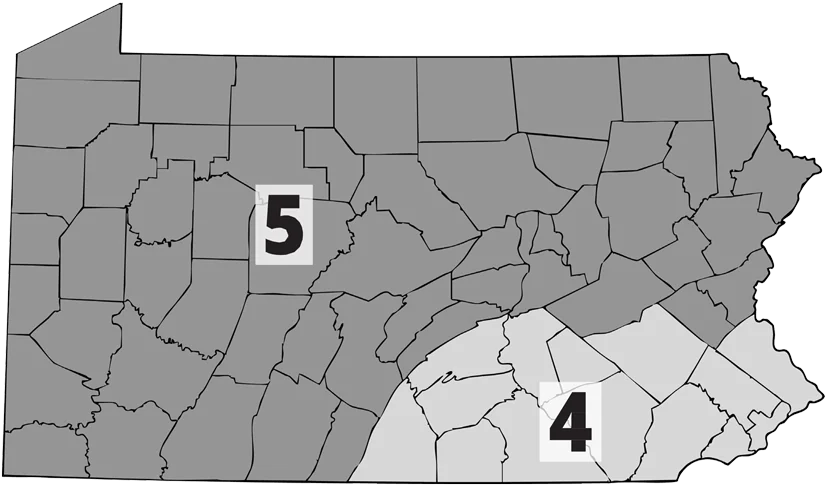
Our state falls into two climate zones: zone 4A, a mixed humid zone, and zone 5A, a cool humid area. Most of Pennsylvania falls into climate zone 5A, but a small cluster of southern Pennsylvania counties is classified as climate zone 4A. These counties include Adams, Berks, Bucks, Chester, Cumberland, Dauphin, Delaware, Franklin, Lancaster, Lebanon, Montgomery, Perry, Philadelphia, and York.
For Pennsylvania building code insulation under the 2021 prescriptive path, new homes must be built with the following minimum amount of insulation:
- Ceilings/Attics: (Climate zones 4 and 5) R-49
- Wood-frame walls: (Climate zone 4) R-20 or R-13+5ci; (Climate zone 5) R-23 or R-13+7ci
- Floors: (Climate zone 4) R-19; (Climate Zone 5) R-30
*ci = continuous insulation
Check out the “Summary of Key Residential Energy Code Requirements” for a more detailed look at all the building envelope and duct requirements for Pennsylvania homes in the 2021 PA UCC.
What “Minimum” Really Means
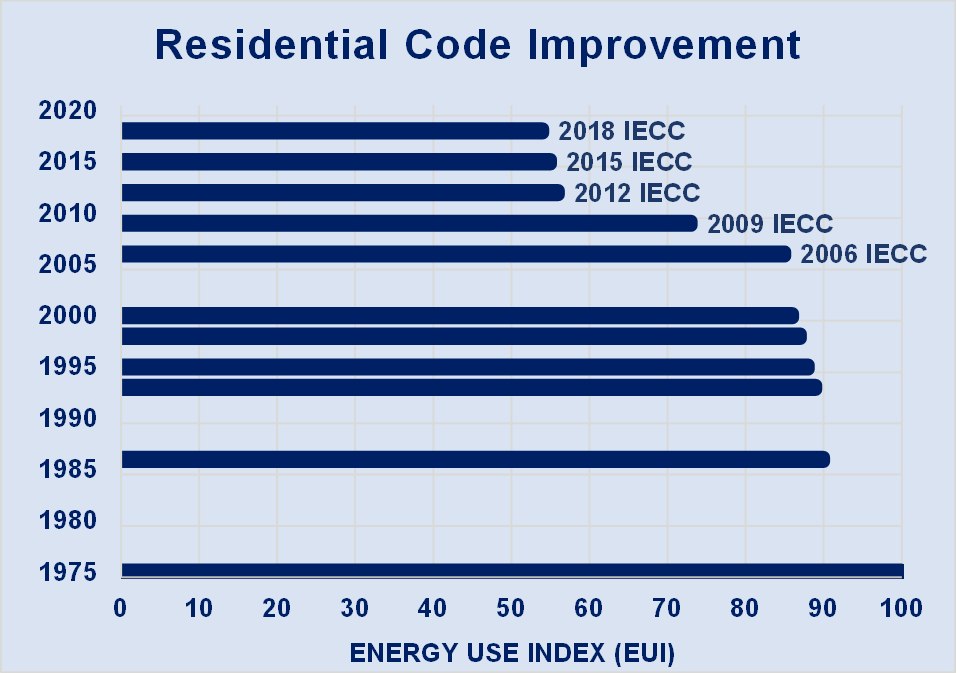
Code minimums are the lowest level of insulation a builder can install and still pass inspection. They are not designed to maximize comfort, minimize bills, or account for our state’s extreme seasonal temperature swings. They are simply a minimum baseline for safety, health, and energy efficiency. But with each set of updated, approved state standards, efficiency does improve, even though it may not maximize a home’s energy efficiency.
Homes built to newer standards use less energy than homes previously built following older energy standards. For example, a house built to the 2018 PA UCC standards uses nearly 50% less energy than one built to 1975’s standards, and about 25% less than a house built to the 2009 standards. The chart below shows the differences in energy efficiency in Pennsylvania homes from 1975 through 2018.
What ENERGY STAR and the DOE Actually Recommend
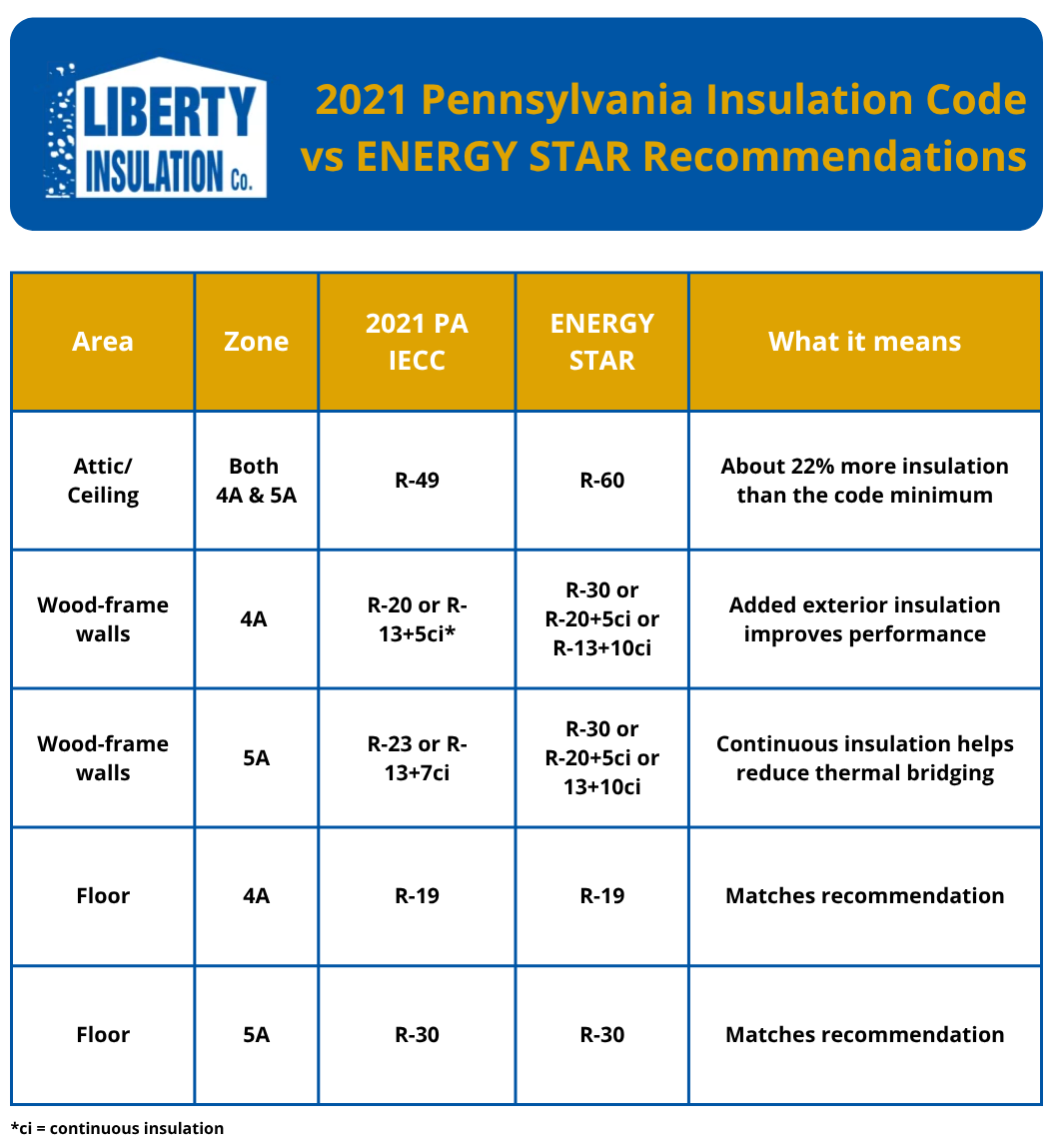
The Department of Energy’s ENERGY STAR recommendations for retrofitting existing wood-framed homes in Pennsylvania differ somewhat from the state’s UCC for energy efficiency, especially in attics. State standards require R-49 attic insulation in both climate zones 4 and 5, while ENERGY STAR recommends R-60 for an uninsulated attic.
On walls and floors, the picture is more mixed. Floors in zones 4 and 5 generally align with ENERGY STAR guidance at R-19 and R-30, but wall recommendations often go further by encouraging additional continuous insulation during re-siding projects. That added layer helps reduce thermal bridging and improves home energy efficiency Pennsylvania homeowners can actually feel in both summer and winter.
With a variety of homes and conditions, you can see why PA climate zone insulation decisions are never one-size-fits-all. The chart compares the 2021 PA energy code with ENERGY STAR’s insulation recommendations.
For more information, check out the full 2021 PA Energy Code and the full 2021 IECC that the ENERGY STAR recommendations are based on.
Why the Gap Matters in Pennsylvania
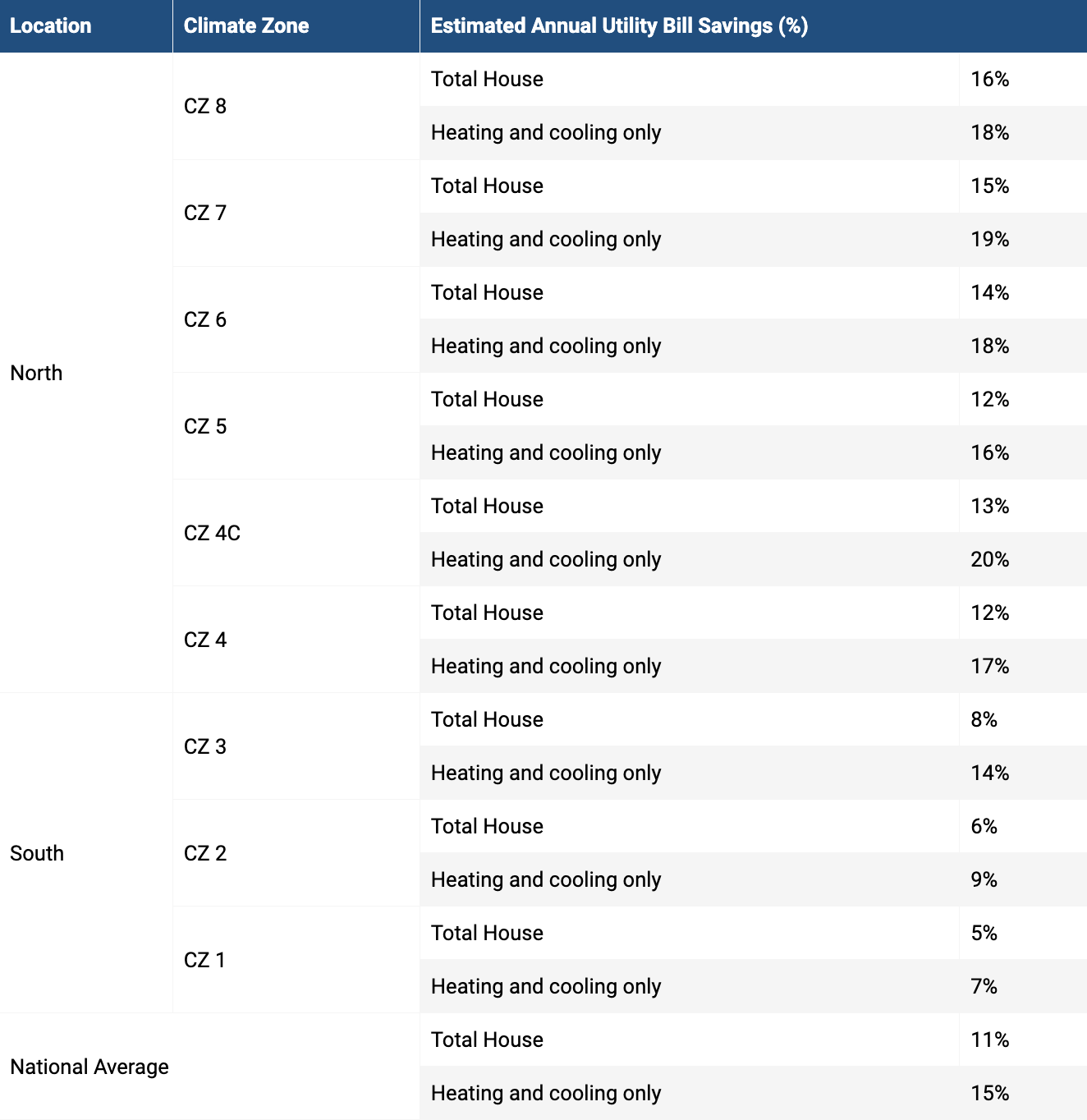
The savings side matters too. The Environmental Protection Agency (EPA) estimates homeowners can save an average of 15% on their heating and cooling costs by air sealing and upgrading insulation. And in an analysis of Pennsylvania homes, insulation upgrades (such as adding insulation to walls, attics, and foundations) were among the top cost-effective energy efficiency improvements homeowners can make. Here in Pennsylvania, where our heating season is long and our summers can still drive AC use, those savings quickly add up over time.
The table shows how much you can save by air sealing and insulating your home.
Which Upgrades Deliver the Best Return
Priority 1: Attic Insulation
For most homes, the attic is the best place to begin because energy savings often start at the top, where warm air escapes in winter and radiant heat from the roof pushes into your home in summer. Upgrading your attic insulation with blown-in cellulose or fiberglass insulation, increasing from the state minimum of R-49 to the recommended R-60, is often the fastest path to better performance, especially in older homes that fall below today’s recommendations.
Priority 2: Air Sealing + Wall Insulation
Insulation works best when it’s paired with air sealing Pennsylvania homeowners can count on. The DOE notes that air sealing should accompany insulation for home efficiency, health, and comfort. For wall upgrades, blown-in insulation can help fill existing empty wall cavities without removing drywall. Spray foam insulation can also be a smart option for rim joists, problem areas, and other hard-to-reach spaces because it insulates and air seals in one step.
Priority 3: Basements and Crawl Spaces
Basements and crawl spaces are often overlooked, especially in older homes. This is why many older Pennsylvania houses have little or no insulation in those areas. ENERGY STAR and the state UCC recommend at least R-10 continuous or R-13 cavity insulation for basement and crawl space walls in zone 4 and R-15 continuous or R-19 cavity insulation in zone 5. Insulating and sealing the crawl space envelope can also help manage moisture and reduce heat loss through the floors above. Spray foam insulation, especially closed cell spray foam, is an effective choice for these areas.
Frequently Asked Questions
Q: What insulation does the 2021 IECC require for attics in Pennsylvania?
A: Zone 4 and 5 areas, including York, require R-49 in ceilings and attics under the prescriptive compliance path.
Q: What R-value does ENERGY STAR recommend for Pennsylvania attics?
A: ENERGY STAR recommends R-60 for uninsulated attics and R-49 for attics that already have about 3 to 4 inches of insulation, across all PA climate zones.
Q: How much can I save by insulating beyond code minimums?
A: ENERGY STAR estimates homeowners can save about 15% on heating and cooling costs, or 11% on total energy costs, by sealing air leaks and adding insulation in key areas.
Q: What type of insulation is best for Pennsylvania homes?
A: Blown-in cellulose and fiberglass are cost-effective for attic upgrades. Spray foam provides both insulation and air sealing in a single application, making it ideal for walls, rim joists, and hard-to-reach areas. The best choice depends on the area of your home, budget, and performance goals.
Q: Did Pennsylvania adopt a new energy code?
A: Yes. The new 2021 residential energy code went into effect on January 1st, 2026 for new design contracts and permits, with a transition period for projects already underway under the 2018 code.
Q: Are there rebates or incentives for insulation upgrades in Pennsylvania?
A: Although the federal 25C insulation tax credit expired at the end of 2025, homeowners should still check with their local utility providers and the PA Weatherization Assistance Program for current rebates and assistance programs.
Liberty Insulation is Your Partner in Energy Efficiency
Building code is the starting line, not the finish line. Pennsylvania homeowners who insulate beyond the code minimum enjoy lower energy bills, more consistent comfort year-round, and better long-term home value. The biggest opportunity for many homes is still the attic, where upgrading to R-60 insulation (along with air sealing) is the most impactful insulation improvement, regardless of climate zone.
Since 1987, Liberty Insulation has helped Pennsylvania homeowners improve comfort, control energy loss, and choose insulation solutions that make sense for their homes, not just for inspection day. If you want real answers about your attic, walls, basement, or crawl space, count on us for experienced guidance, professional installation, and a plan built around lasting performance. Contact us today to schedule your free estimate.
References
ENERGY STAR. “Methodology for Estimated Energy Savings from Sealing and Insulating.” U.S. Environmental Protection Agency, www.energystar.gov/saveathome/seal_insulate/methodology.
ENERGY STAR. “Recommended Home Insulation R–Values.” U.S. Environmental Protection Agency, www.energystar.gov/saveathome/seal_insulate/identify-problems-you-want-fix/diy-checks-inspections/insulation-r-values.
ENERGY STAR. “Why Seal and Insulate?” U.S. Environmental Protection Agency, www.energystar.gov/saveathome/seal_insulate/why-seal-and-insulate.
ENERGY STAR. “Why Seal and Insulate?” U.S. Environmental Protection Agency, www.energystar.gov/saveathome/seal_insulate/why-seal-and-insulate.
Insulation Institute. “Pennsylvania Uniform Construction Code: Summary of Key Residential Energy Code Requirements.” NAIMA. https://insulationinstitute.org/wp-content/uploads/2025/12/N109-PA-Energy-Code-1225.pdf.
National Renewable Energy Laboratory. “Pennsylvania Residential Energy Efficiency Potential.” ResStock, U.S. Department of Energy, http://resstock.nrel.gov/factsheets/PA.
Pennsylvania Department of Environmental Protection. “Building Energy Codes Training.” State of Pennsylvania, www.dep.pa.gov/Business/Energy/OfficeofPollutionPrevention/State-Energy-Plan/Pages/Building-Energy-Codes-Training.aspx.
Pennsylvania Housing Research Center. “2021 Pennsylvania Alternative Residential Energy Provisions.” Penn State University, www.phrc.psu.edu/assets/docs/Publications/2021-PA-Alternative-Residential-Energy-Provisions.pdf.
Pennsylvania Housing Research Center. “Code Update Training.” Penn State University, www.phrc.psu.edu/industry-education/Resources/Code-Update-Training.aspx.
Pennsylvania Housing Research Center. “Energy Code Enforcement and Compliance in Pennsylvania: Lessons from the Field.” Penn State University, www.phrc.psu.edu/assets/docs/Publications/106EnergyCodeEnforcementTurns.pdf.
UpCodes. “Pennsylvania Energy Code 2021.” https://up.codes/viewer/pennsylvania/iecc-2021/chapter/RE_4/re-residential-energy-efficiency#RE_4.
U.S. Department of Energy. “Building Energy Codes Program: Pennsylvania.” Office of Energy Efficiency and Renewable Energy, www.energycodes.gov/status/states/pennsylvania.
U.S. Department of Energy. “Insulation.” Energy Saver, www.energy.gov/energysaver/insulation.