
Most Pennsylvania homeowners assume Pennsylvania insulation requirements are the same across the state. While that’s a reasonable assumption, it’s incorrect. Pennsylvania spans two different IECC climate zones, and the minimum R-values in the building code depend entirely on which climate zone and county your home sits in.
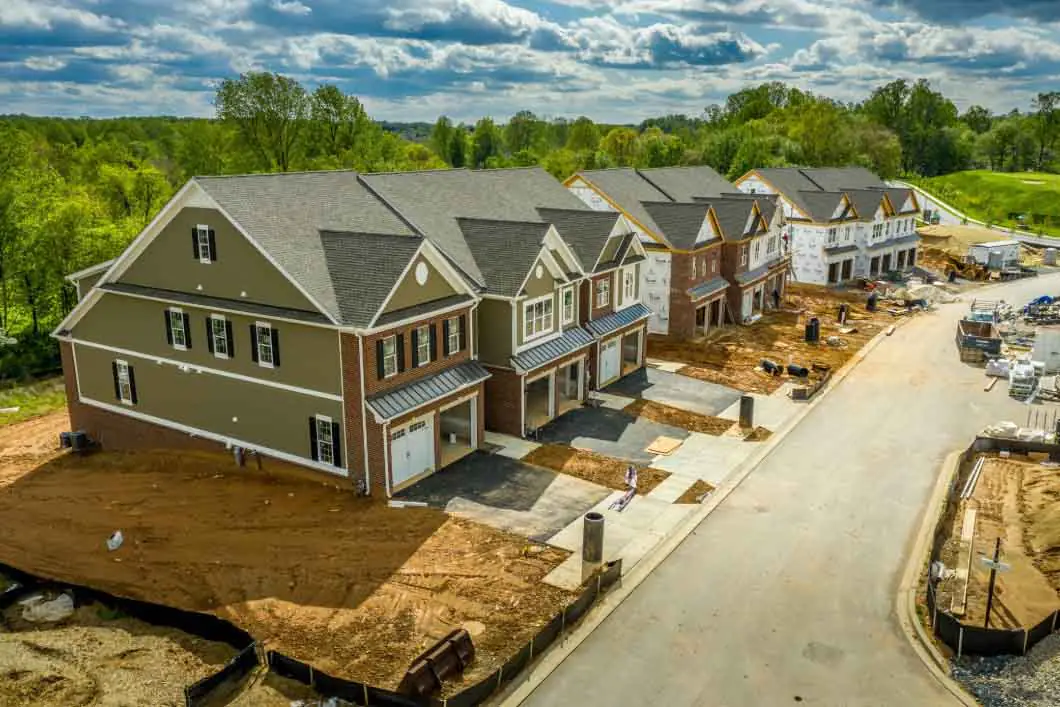
Heating and cooling account for more than half of a typical home’s energy use. A home that’s under-insulated for its specific zone wastes energy every month. On new construction, building to the wrong spec risks a failed code inspection. To create more energy-efficient homes, our state officially adopted the latest Pennsylvania IECC requirements in January of 2026.
This guide explains why Pennsylvania is split into two climate zones, identifies which counties fall into each, and provides the R-value specifications for every part of a home in each zone.
Not sure which climate zone covers your county or whether your existing insulation meets your zone’s R-value minimums? An insulation evaluation can identify the gaps.
Why Pennsylvania Has Two Climate Zones and What Code Applies Today
The International Energy Conservation Code (IECC) divides the U.S. into climate zones based on heating and cooling degree-days. The Pacific Northwest National Laboratory, on behalf of the U.S. Department of Energy, publishes the official climate-zone-by-county data files used to make those assignments.
Pennsylvania’s geography is genuinely varied. The southeast corner sits in a mild, Atlantic-influenced climate. Head north toward the New York border, into Potter, Tioga, and McKean counties, and winters are colder with a deeper frost line. One R-value can’t cover the whole state.
Pennsylvania falls into two zones: 4A (mixed-humid) and 5A (cool-humid). The “A” means moist, as Pennsylvania has no dry or marine zones. The Pennsylvania Department of Labor and Industry formally adopted Pennsylvania’s IECC requirements, the revised 2021 IECC, through the Uniform Construction Code Review and Advisory Council. Passed with state-specific amendments, the new code became effective January 1, 2026.
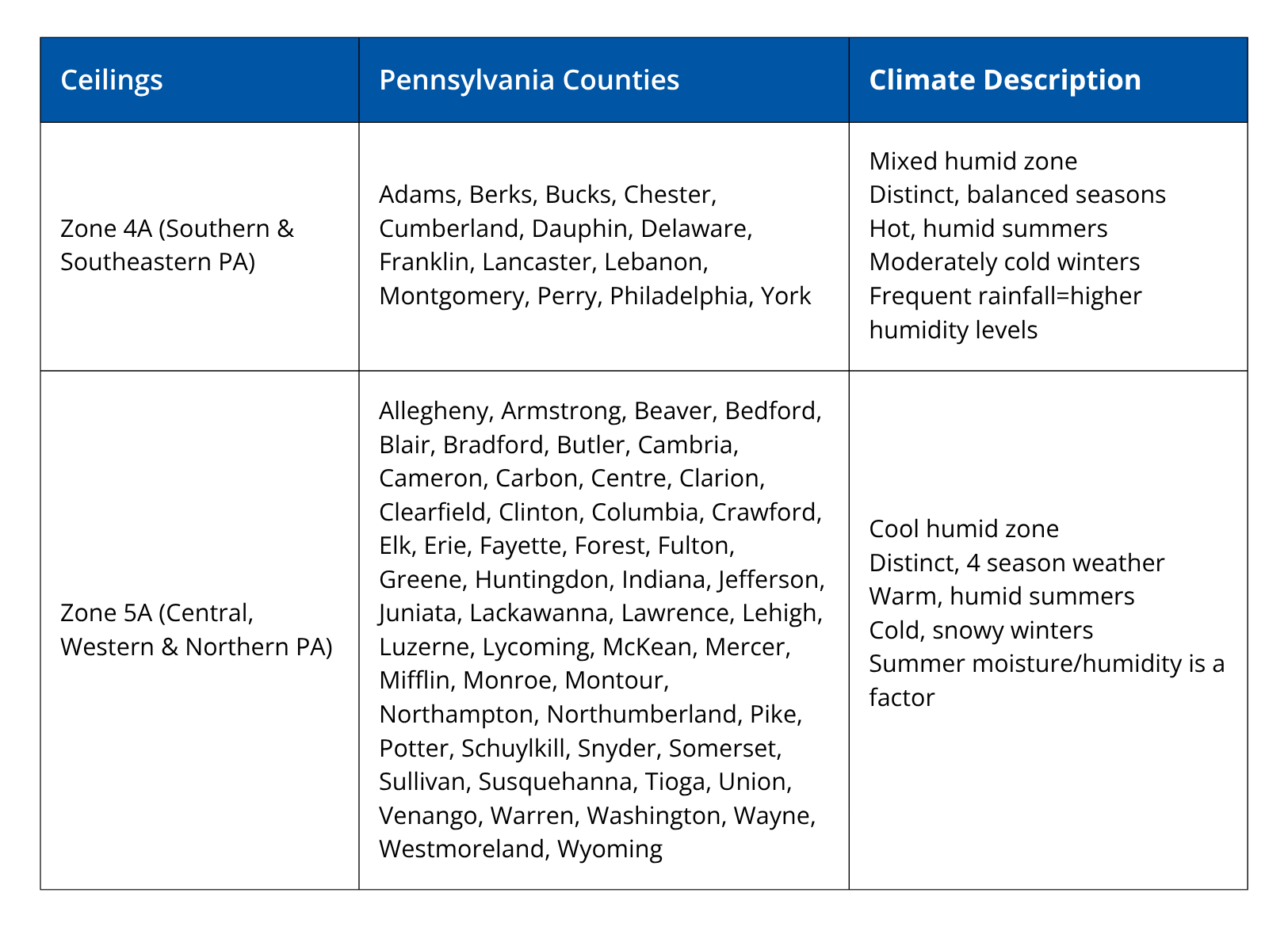
Which Counties Fall in Each Zone
The southeastern counties are assigned to Climate Zone 4A, a mixed humid area. The milder winter weather in this zone means lower prescriptive R-value minimums than in Zone 5A.
Zone 5A covers the rest of the state, including the central, western, and northern counties. Its colder climate calls for higher R-value minimums for a more energy-efficient home.
R-Value Specs by Climate Zone (Under PA’s Adopted 2021 IECC)
These are prescriptive minimums for one- and two-family dwellings. They are minimum requirements, not maximums, and you can always exceed them.
Zone 4A, Southeastern PA (including York County)
- The ceiling/attic R-value is R-49.
- The wood frame wall R-value in Pennsylvania is R-20 cavity or R-13 cavity + R-5 continuous insulation.
- Floor insulation over unconditioned space is R-19.
- Pennsylvania basement wall R-value is R-10 continuous or R-13 cavity.
- Slab edge R-value is R-10 to 2 feet depth.
- Crawl space wall insulation R-value in PA is R-10 continuous or R-13 cavity.
Zone 5A, Most of Pennsylvania
- The ceiling/attic R-value is R-49.
- The wood frame wall R-value in Pennsylvania is R-23 cavity or R-13 cavity + R-7.5 continuous or R-20 cavity + R-3.8 continuous.
- Floor insulation over unconditioned space is R-30.
- Pennsylvania basement wall R-value is R-15 continuous or R-19 cavity.
- Slab edge R-value is R-10 to 4 feet depth or R-15 to 3 feet depth.
- Crawl space wall insulation R-value in PA is R-15 continuous or R-19 cavity.
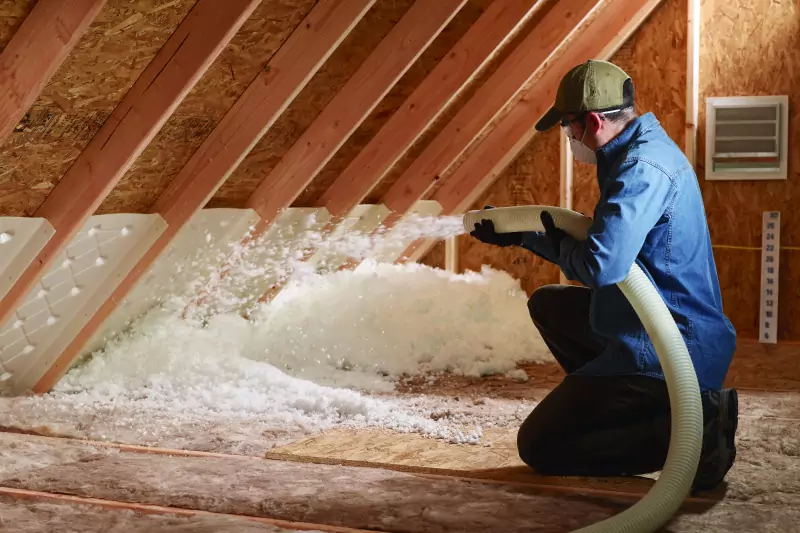
Blown-in fiberglass insulation is the most common product for reaching R-49 in Pennsylvania attics, while closed-cell spray foam insulation delivers high R-value per inch in cavity and continuous applications.
What Stays the Same Across Both Zones
R-49 attic insulation is the one constant statewide, whether you live in York County or Potter County. Attic heat loss in winter, and heat gain in summer, is the biggest single envelope opportunity in most homes. Proper attic/ceiling insulation provides the greatest energy savings, and Pennsylvania prioritizes it statewide.
What Changes the Most as You Move from Zone 4 to Zone 5
The biggest jumps moving from Zone 4 to Zone 5 are the requirements for other parts of the home, including the floors, exterior walls, crawl space walls, basement walls, and the slab depth. For instance, the insulation requirement for floors over unconditioned spaces jumps from R-19 in Zone 4 to R-30 in Zone 5. These increases in required R-values reflect variations in climate and energy-efficiency needs.
Frequently Asked Questions
Q: What IECC climate zone is York, PA in?
York County is in IECC Zone 4A under the federal county-level zone designation referenced by Pennsylvania’s adopted Uniform Construction Code.
Q: Did Pennsylvania adopt the 2021 IECC?
Yes. The Pennsylvania Department of Labor and Industry, through the Uniform Construction Code Review and Advisory Council, formally adopted the 2021 International Codes, including the 2021 IECC, with Pennsylvania-specific amendments, effective January 1, 2026.
Q: Why is the ceiling R-value (R-49) the same across both PA climate zones?
Attic heat transfer is the largest single envelope opportunity in most local homes. Installing R-49 attic insulation in Pennsylvania homes is the prescriptive minimum across both zones because most heat loss in winter and heat gain in summer happens through the top of the building envelope.
Q: What’s the difference between cavity insulation and continuous insulation in the wall R-value spec?
Cavity insulation fills the space between wall studs. Continuous insulation runs across the outside of the framing, typically rigid foam board, preventing heat from short-circuiting through the wood studs (thermal bridging).
Q: Can I exceed the IECC minimum R-values in my Pennsylvania home?
Yes. R-value minimums in the code are floors, not ceilings. Many Pennsylvania homeowners, particularly in older homes, choose to go beyond the prescriptive minimum to cut heating costs and improve year-round comfort.
York County Homeowners: Liberty Insulation Has Your Zone Covered
Pennsylvania isn’t one climate; it’s two. The right spec for any home depends on its county. Whether you’re in southeastern Pennsylvania insulation Zone 4A or Zone 5A across central and western PA, getting the R-value right across every part of your home is what’s important. It separates a home that’s comfortable and efficient from one that runs cold in winter, hot in summer, and expensive year-round.
York County homeowners can count on Liberty Insulation. Based right here in York, we know both Zones 4A and 5A inside and out. Our team has been helping south-central Pennsylvania homeowners get their insulation right since 1987. We will confirm your climate zone, walk through the R-value spec that applies, and recommend the right products for your home. Schedule a free estimate today with our residential insulation services team. Call 800-232-6106 (add link to phone number) or visit us online.
References
ENERGY STAR. “Recommended Home Insulation R-Values.” U.S. Environmental Protection Agency, www.energystar.gov/saveathome/seal_insulate/identify-problems-you-want-fix/diy-checks-inspections/insulation-r-values.
Insulation Institute. “Pennsylvania Uniform Construction Code: Summary of Key Residential Energy Code Requirements.” NAIMA. https://insulationinstitute.org/wp-content/uploads/2025/12/N109-PA-Energy-Code-1225.pdf.
Pennsylvania Department of Labor and Industry, Uniform Construction Code Review and Advisory Council. “2021 ICC Code Adoption Final Report.” Commonwealth of Pennsylvania, 14 Sept. 2024, www.pa.gov/content/dam/copapwp-pagov/en/dli/documents/ucc/documents/2021%20icc%20code%20adoption%20final%20report.pdf.
Pennsylvania Department of Labor and Industry. “Uniform Construction Code.” Commonwealth of Pennsylvania, www.pa.gov/agencies/dli/programs-services/labor-management-relations/bureau-of-occupational-and-industrial-safety/uniform-construction-code-home.
Pennsylvania Housing Research Center. “2025 Pennsylvania Alternative Residential Energy Provisions.” The Pennsylvania State University, Apr. 2025, www.phrc.psu.edu/assets/docs/Publications/2025-Pennsylvania-Alternative-Residential-Energy-Provisions.pdf.
Pacific Northwest National Laboratory. “Guide to Determining Climate Zone by County: Data Files.” Building America Solution Center, U.S. Department of Energy, basc.pnnl.gov/guide-determining-climate-zone-county-data-files.
Pacific Northwest National Laboratory. “Climate Zone Map from IECC 2021.” Building America Solution Center, U.S. Department of Energy, basc.pnnl.gov/images/climate-zone-map-iecc-2021.
UpCodes. “Pennsylvania Energy Code 2021.” https://up.codes/viewer/pennsylvania/irc-2021/chapter/11/re-energy-efficiency#11.
U.S. Department of Energy. “Insulation.” Energy Saver, Office of Energy Efficiency and Renewable Energy, www.energy.gov/energysaver/insulation.
U.S. Energy Information Administration. “Use of Energy Explained: Energy Use in Homes.” EIA, https://www.eia.gov/energyexplained/use-of-energy/homes.php.